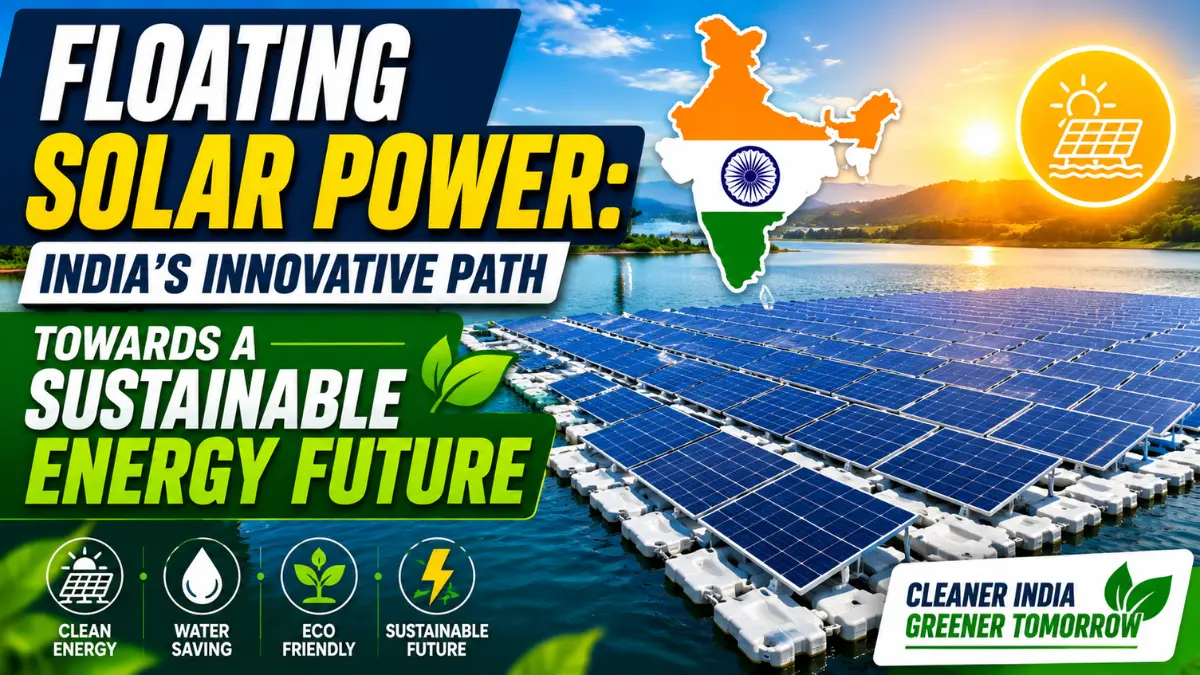
Floating Solar Power: As India is transitioning towards clean energy, country face a significant challenge—finding enough land to install large-scale solar power plants without affecting agriculture, forests, or human settlements. To address this challenge, Floating Solar Photovoltaic (FSPV) technology emerged as an innovative and sustainable solution. Unlike conventional solar farms built on land, floating solar panels are installed on the surface of reservoirs, lakes, dams, and other water bodies, allowing India to generate renewable energy while preserving valuable land resources.
With the national target of achieving 500 GW of non-fossil fuel electricity capacity by 2030 and Net Zero emissions by 2070, floating solar projects are becoming an important pillar of India’s renewable energy strategy. Beyond electricity generation, these projects offer multiple environmental and economic benefits, making them one of the most promising innovations in the country’s green energy journey.
Role of Floating Solar Power Projects in Achieving India’s Renewable Energy Targets
Table of Contents
Reduces Land Requirement
- Scarce agricultural and forest land are conserved.
- Unused surface water can be used productively.
Example: The Omkareshwar Floating Solar Power Project (Madhya Pradesh) is among the world’s largest floating solar projects. Instead of valuable land, utilizing a reservoir.
Enhances Energy Generation
- As water cools solar panels, reduced operating temperature has improved efficiency.
- Resulted higher electricity output compared to many ground-mounted systems.
Conserves Water Resources
- Reduced evaporation from reservoirs and lakes due to installed Floating panels.
- It helps to improve water availability in water-scarce regions.
Example: Floating solar installations on irrigation reservoirs in Telangana have demonstrated the dual benefits of power generation and reduced water loss.
Supports Energy-Water-Food Nexus
- It simultaneously supports irrigation, hydropower, fisheries, and solar power.
- Promotes optimal utilization of infrastructure for public good.
Complements Hydropower
- Shares transmission infrastructure with hydroelectric projects.
- During daytime conserves water for peak electricity demand.
Example: NTPC’s Ramagundam Floating Solar Power Project (Telangana) integrated with an existing thermal power station’s water reservoir, showcasing efficient infrastructure utilization.
Climate Commitment Contribution
- Lowers dependence on fossil fuels and reduces greenhouse gas emissions.
- Give strength to India’s commitments under the Paris Agreement and the Panchamrit goals.
Major Implementation Challenges
High Initial Investment
- Increased investments due to Floating structures, anchoring systems, corrosion-resistant materials, and specialized installation.
Technical Challenges
- Fluctuating water levels, strong winds, waves, and cyclones affect structural stability.
- Corrosion and biofouling increases maintenance cost.
Example: Reservoirs in cyclone-prone areas demands strong anchoring systems, increasing project cost.
Environmental Concerns
- Excessive coverage of water surfaces will reduce sunlight penetration, affecting aquatic ecosystems.
- Potential impact on fisheries and biodiversity need careful assessment.
Regulatory and Institutional Issues
- Multiple agencies govern reservoirs, irrigation departments, and electricity utilities, causing delays in approvals.
- No uniform policy guidelines across the nation.
Grid Integration
- In-adequate transmission infrastructure in remote reservoir locations.
- Demands improved grid flexibility and storage for variable solar generation.
Financing Constraints
- Higher perceived risks increase financing costs.
- Limited domestic manufacturing of specialized floating components.
Measures to Promote Floating Solar Power
Policy Measures
- Comprehensive national policy for floating solar deployment need of the hour.
- Simplify inter-agency approvals and environmental guidelines should be standardized.
Technological Measures
- Indigenous manufacturing should be promoted for floating platforms and corrosion-resistant materials.
- Integrate floating solar with battery storage and smart grids.
Environmental Measures
- Conduct rigorous Environmental Impact Assessments (EIA).
- Limit reservoir coverage to protect aquatic biodiversity.
- Continuous ecological monitoring must be encouraged.
Financial Measures
- Initiate viability gap funding expansion and concessional green finance.
- To promote Public-Private Partnerships (PPP) and carbon finance mechanisms.
Research & Innovation
- Develop durable anchoring systems suited as per Indian climatic conditions.
- Hybrid floating solar–hydropower projects must be encouraged.
Example: The Kayamkulam Floating Solar Power Plant (Kerala) demonstrates how innovation can utilize limited land resources while expanding renewable energy generation.
Way Forward
- Prioritize floating solar power deployment on major reservoirs owned by central and state utilities.
- Integrate floating solar into river basin and reservoir management plans.
- Promote domestic R&D under the National Green Hydrogen Mission and renewable manufacturing initiatives.
- Encourage state-specific floating solar roadmaps based on hydrological potential.
- Strengthen skill development for installation and maintenance of floating solar systems.
Important Links For Floating Solar Power Projects
| Read About The Tata Projects In India | Click Here |
| Official Website Of Solar Projects | Click Here |
| All New Updates | Click Here |
Conclusion
Floating solar power technology represents far more than an alternative method of generating electricity—it symbolizes India’s ability to pursue innovation while addressing multiple developmental challenges simultaneously. By conserving land, reducing water evaporation, improving solar efficiency, and complementing existing hydropower infrastructure, floating solar offers a practical pathway toward sustainable energy expansion.
Although technical, financial, and regulatory challenges remain, the country’s growing experience with large-scale projects demonstrates that these barriers can be overcome through sound policy, indigenous innovation, and coordinated planning. As India advances toward its ambitious renewable energy targets, floating solar is poised to become a vital contributor to a cleaner, more resilient, and resource-efficient energy future.